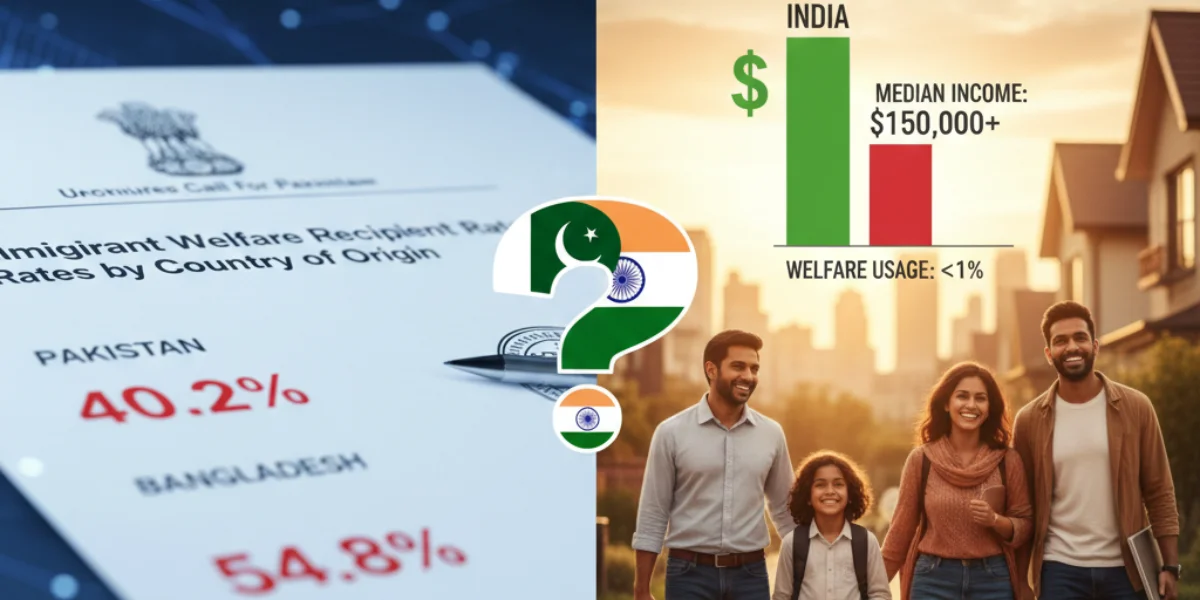
The recent release of the “Immigrant Welfare Recipient Rates” chart by the U.S. administration has sent shockwaves across social media. The data shows several South Asian nations including Pakistan at 40.2% and Bangladesh at 54.8%, as high users of public assistance. Meanwhile, India is nowhere to be found on the list.
For the Pakistani audience, this shouldn’t be a cause for offense, but a moment for introspection. Why is there such a massive disparity between two neighbors?
The Data Breakdown: Why India Isn’t on the List
The primary reason India is absent from the “welfare receiver” list is simple: The Indian diaspora in the U.S. is currently the highest-earning ethnic group in the country.
According to Pew Research and U.S. Census data, the median household income for Indian-Americans has surpassed $150,000. Because welfare (like SNAP or Medicaid) is “means-tested” (only available to those below a certain income level), the vast majority of Indian immigrants simply do not qualify for it. They are “net contributors”—paying more in taxes than they receive in benefits.
3 Key Reasons for the Gap (Pakistan vs. India)
1. The “H-1B” Filter vs. Family Reunification
A significant portion of Indian migration to the U.S. over the last 30 years has been through employment-based visas (H-1B). These visas require a minimum of a Bachelor’s degree and a high-paying job offer. In contrast, a larger percentage of Pakistani migration has historically relied on family sponsorship, which does not have the same immediate income or education requirements, often leading to a slower economic start for new arrivals.
2. Sector Specialization
Indian immigrants are heavily concentrated in STEM (Science, Technology, Engineering, and Math) and Healthcare. These sectors are not only the highest paying in the U.S. but also offer the most stability. While many Pakistanis also excel in these fields, a larger segment of the Pakistani diaspora is involved in small business, transport, and service sectors, which were hit harder by recent economic fluctuations, leading to a higher temporary reliance on social safety nets.
3. Educational Attainment
Statistical data shows that nearly 80% of Indian immigrants in the U.S. hold a college degree or higher. For the Pakistani-American community, while the number is respectable, it sits lower. Higher education levels directly correlate to lower welfare dependency.
Is This a “Win” or a “Loss”?
It is important for the Pakistani audience to understand that being on the welfare list isn’t necessarily a sign of “laziness.” Many Pakistani immigrants arrive as refugees or through family channels and use welfare as a stepping stone to build a life from scratch.
However, the “Indian Model” shows that when a country exports its most highly-educated talent (the “Brain Drain” paradox), those individuals become a powerful tool for soft power and economic remittances.
US Immigrant Welfare Participation Rates
The following table highlights the top welfare-dependent immigrant groups alongside regional peers for context. Note that India is absent from the official list of 120+ countries, as its participation rate is statistically negligible due to high median incomes
| Rank | Country of Origin | Welfare Recipient Rate (%) | Significance for Analysis |
| 1 | Bhutan | 81.4% | Highest rate globally; often linked to refugee status. |
| 2 | Yemen | 75.2% | High usage due to ongoing humanitarian crises. |
| 6 | Afghanistan | 68.1% | Reflects recent resettlement and initial state support. |
| 21 | Bangladesh | 54.8% | Highest in the immediate South Asian region. |
| 23 | Mexico | 54.0% | Key benchmark for US domestic immigration debate. |
| 35 | Pakistan | 40.2% | Significantly higher than the Asian-American average. |
| 45 | Asia (Other/Unspecified) | 38.8% | Catch-all for smaller or unspecified Asian nations. |
| N/A | India | Exempt / <1% | Not listed; Indian-American median income is $151,200. |
The Bottom Line
India’s absence from the list is a testament to a decades-long focus on technical education and merit-based migration. For Pakistanis, the lesson is clear: to change the narrative on the global stage, the focus must shift toward high-tech skill development and educational reform that prepares our youth for the global high-wage economy.
Be First to Comment